The Future of Boat Marketing Is Removing Friction, Not Creating Demand
Why They Don't Buy: The Science of Unblocking Human Behavior
The future of marketing isn't about creating more desire. It's about removing the obstacles that prevent motivated people from acting.
Many marketers have operated under a remarkably persistent assumption: if customers aren't buying a boat, they simply haven't been convinced yet. The solution has almost always been the same. Increase the advertising budget. Produce more content. Refine the messaging. Add another feature. Build another campaign. Somewhere, somehow, enough persuasion will tip the balance.
It's an understandable philosophy, but behavioral science suggests it's fundamentally flawed. Most people don't fail to act because they lack motivation. They fail because something blocks them from doing what they already want to do.
That distinction may seem subtle, but it has profound implications for how businesses approach growth. Rather than investing enormous resources trying to manufacture desire, the most successful brands focus on something far simpler: identifying and removing the friction that prevents motivated customers from moving forward.
For companies selling luxury recreational assets, particularly in the marine industry, this shift in thinking represents one of the most significant opportunities in modern marketing.
The Marketing Myth: Persuasion Creates Demand
Traditional marketing is largely built around the pursuit of motivation. Campaigns are designed to inspire, excite and persuade. Yet genuine intrinsic motivation is surprisingly resistant to external influence. People either aspire to a particular lifestyle or they don't. They either imagine themselves on the water or they never will.
Behavioural researchers have long observed that success rarely comes from changing people's minds. Instead, it comes from helping those who have already made up their minds, but haven't yet acted. As BJ Fogg, founder of the Stanford Behavior Design Lab, has often emphasized, the goal is not to manufacture motivation but to increase a person's ability to act on the motivation they already possess.
This philosophy transforms marketing from an exercise in persuasion into one of facilitation. Instead of chasing the small percentage of consumers who may never become customers, businesses begin serving the much larger group who already want the outcome but encounter unnecessary barriers along the way.
In practical terms, this means asking a different question. Rather than wondering how to convince more people to buy, marketers should ask what is preventing willing buyers from taking the next step.
Ability Is the Real Driver of Behavior
One of the central ideas in behavior design is deceptively simple: behavior only occurs when motivation and ability exist at the same moment.
Marketing departments often devote extraordinary attention to increasing motivation while overlooking the variable that actually determines whether action happens: ability.
Ability is frequently misunderstood as skill or intelligence. In reality, it is a measure of how easy something feels to accomplish under current circumstances. Even highly motivated consumers abandon purchases when the process demands more time, money or mental effort than they have available in that particular moment.
This is where behavioral science introduces the concept of the "weakest link." Every customer journey depends upon a chain of actions. If any one link requires resources the customer cannot spare, the entire behavior collapses.
For luxury purchases, ability falls on three crucial resources. The first is time. Modern consumers constantly balance competing demands. A buying journey that requires lengthy research, multiple enquiries or excessive paperwork quickly becomes something to postpone, regardless of how attractive the product may be.
The second is financial accessibility. This extends beyond affordability. Luxury buyers often possess the means to purchase, but uncertainty around financing, trade-ins, delivery or ownership costs creates hesitation. Removing ambiguity frequently proves more valuable than reducing price.
Perhaps the most underestimated factor is cognitive load. Every additional decision, confusing webpage, inconsistent message or poorly designed navigation system consumes mental energy. Decision fatigue is real, and it quietly erodes conversion rates across every industry. Luxury brands occasionally mistake complexity for sophistication when, in reality, clarity is far more persuasive.
Small Behaviors Lead to Significant Commitments
One of the most compelling ideas in behavior design is that people rarely make large decisions in a single leap. Instead, they move through a sequence of increasingly comfortable actions. This progression, sometimes described as a behavior chain, explains why the highest-performing digital experiences feel effortless rather than persuasive.
The first step should always be exceptionally easy. For luxury boat manufacturers, that first interaction might be an online configurator allowing visitors to customize their dream vessel, compare layouts or explore premium options. Importantly, the configurator is not simply a sales tool. It functions as what behavior designers call a facilitator. Rather than attempting to increase motivation, it increases ability by making engagement feel enjoyable, intuitive and entirely without pressure.
Once prospective buyers have invested time designing a boat that reflects their aspirations, subsequent actions begin to feel natural. Requesting pricing, locating a dealer or booking a consultation no longer represents a significant behavioral hurdle because the customer has already invested emotionally in the process.
This is elegant influence at work. The experience never feels like selling. It simply feels like the obvious next step.
Why the 55+ Demographic Is Already Motivated
Understanding behavior also changes how businesses think about audience segmentation.
Within the recreational boating industry, motivation is is concentrated within a demographic that has both the lifestyle aspirations and practical resources necessary for ownership. Buyers aged 55 and over account for more than half of luxury recreational purchases. They also exhibit the highest levels of home ownership and accumulated wealth, two important indicators of behavioral ability.
Home ownership is particularly significant because it often signals something marketers rarely consider: storage capacity. Owning a premium recreational asset requires more than financial resources. It requires physical space, long-term stability and a lifestyle capable of supporting ownership. A home ownership rate exceeding seventy-five percent among buyers reflects far more than demographics. It represents reduced behavioural friction.
Likewise, higher household wealth reduces financial obstacles, allowing marketing efforts to focus less on persuasion and more on simplifying the buying journey.
This is why sophisticated audience targeting extends beyond demographics alone. It identifies where motivation already exists and concentrates on removing the final barriers to action.
Search Is the Clearest Signal of Intent
If marketers want evidence of existing motivation, they need only examine search behavior.
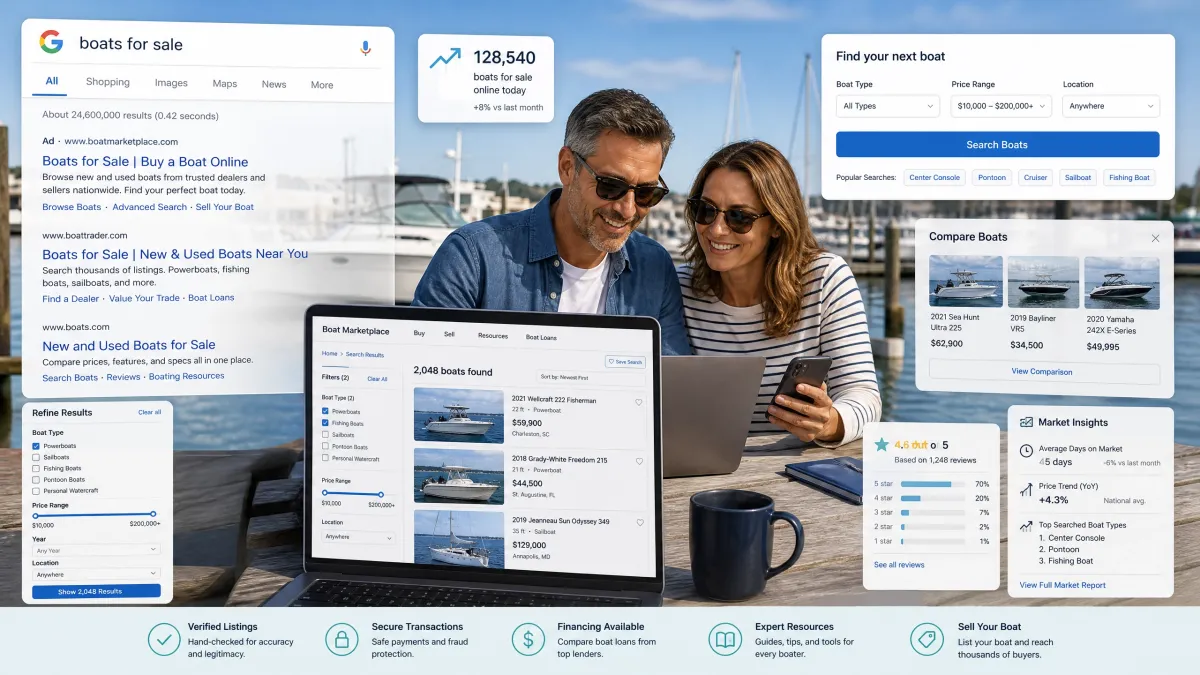
Search engines remain the most powerful indicator of purchase intent because they capture consumers actively seeking solutions. Someone searching for "luxury centre console boats," "custom fishing boat builder" or "best offshore boat under 40 feet" has already progressed well beyond passive awareness.
Within the marine industry, organic and paid search routinely account for between forty and sixty percent of website traffic. Unlike interruption-based advertising, search reflects self-directed behavior. Consumers initiate the conversation because they already possess intrinsic motivation.
Direct website visits reveal similar intent. Returning visitors, bookmarked pages and branded searches frequently represent prospects who have encountered the brand through referrals, social conversations or previous research. Their behavior suggests familiarity, confidence and readiness to continue the buying journey.
Social media undoubtedly plays an important role by introducing brands and inspiring aspiration, but search is where motivation becomes measurable. It is where curiosity evolves into genuine purchase intent.
For marketers, the distinction matters enormously. Awareness campaigns create opportunities. Search marketing captures customers already moving towards a decision.
Designing for Friction, Not Persuasion
Friction appears in countless forms: lengthy enquiry forms, confusing navigation, slow-loading websites, unclear pricing, inconsistent messaging and unnecessary decision points. Individually, each obstacle seems insignificant. Collectively, they become the reason motivated customers fail to convert.
This is why conversion optimization should never be viewed as a purely technical discipline. At its best, it is an application of behavioral science. Every improvement that reduces effort, increases clarity or simplifies decision-making strengthens the customer's ability to act.
The companies that consistently outperform their competitors are rarely those shouting the loudest. More often, they are the ones making every interaction feel effortless.
The Future of Marketing Is Human Behavior
The next generation of marketing will not belong to businesses with the biggest advertising budgets. It will belong to organizations that understand how people actually make decisions.
Behavior design teaches a simple but transformative lesson. Motivation is valuable, but it is rarely the limiting factor. The greatest opportunities for growth lie in identifying where desire already exists and systematically removing the obstacles that prevent action.
For marine brands, this means designing websites that simplify exploration rather than overwhelm it. It means investing in intuitive configurators instead of endless product catalogues. It means recognizing search intent as a stronger buying signal than social engagement, and treating every touchpoint as an opportunity to prompt behavior rather than increase pressure.
Ultimately, the most successful marketing asks a very different question. Not "How do we convince more people?”, but "How do we make it easier for the right people to say yes?"
The answer may prove to be the most profitable marketing strategy of all.