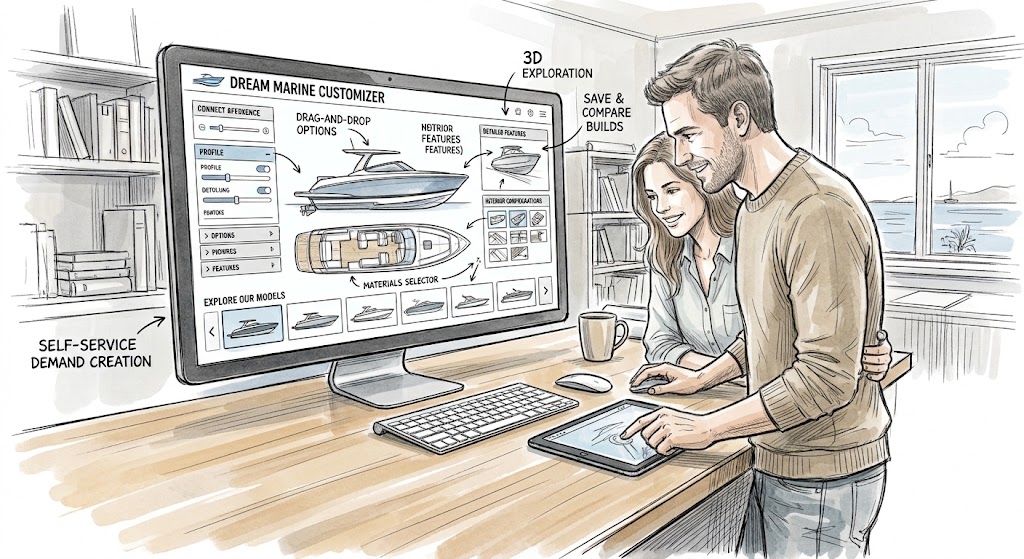
Your Boat Builder Should Create Demand, Not Prevent It
A modern boat builder can be one of the most impressive experiences on a marine OEM website. It can turn an abstract product page into something personal: this is the boat I could own.
Yet many boat builders are designed around only one visitor—the highly informed, late-stage buyer who is ready to configure every detail and request a quote. That person matters. But designing exclusively for that person can turn a powerful demand-generation experience into a narrow qualification gate.
Most visitors who start building a boat are not ready to speak to a dealer. Many are comparing possibilities, learning what is available, imagining a future purchase, or simply enjoying the product. They may not know every option. They may be on a mobile device. They may not be willing to trade contact information for the right to experiment. And they may leave before completing the configuration.
A boat builder should not merely identify people who are ready to buy today. It should help create and recognize the buyers who will be ready tomorrow.
That does not mean the experience failed. A recent configurator-to-owner analysis by Marquatica connected one brand's 2,000 online builder submissions with 207 verified registrations, demonstrating a 10% builder-to-registration conversion rate within the defined attribution window. The remaining 90% of builder sessions were not an unusable outcome, however. The builder measured many interactions beyond the entry point, and provided the OEM with a connection to the vast majority of these interactions with downstream outcomes.
Exploration Is the First Stage of Demand
Exploration is not the opposite of conversion, and it is not evidence of a bad lead. It is often the earliest visible stage of a legitimate buying journey. A prospective buyer who is comparing models, experimenting with layouts, or imagining how a boat might fit their life is giving the OEM valuable signals—even if they are not ready to request a quote today.
The design question is therefore not whether a builder should support exploration or capture serious interest. It should do both, in sequence. A strong builder creates value from the first interaction, records meaningful engagement, and introduces the next appropriate action as the buyer’s interest develops. The visitor does not need to provide everything at once. The system should make each subsequent exchange feel useful and proportionate to the value the buyer has already received.
The result is a more intelligent sales process. By removing unnecessary friction at the beginning, the OEM creates more opportunities to understand what buyers care about.
Mobile is part of the sales strategy
A boat builder that cannot be used effectively on a mobile device has a strategic problem, not only a user-experience problem. If mobile visitors can browse a brand’s models but cannot meaningfully configure, save, or continue a build, the OEM has created only a partial conversion path, or worse, a lead who permanently exits.
Mobile optimization does not necessarily mean duplicating every complex desktop control, but prioritizing the behaviors that advance the journey: selecting a model, understanding the major choices, seeing the result, saving progress, returning later, and asking for help. If a feature is too complex for a small screen, the experience should make a graceful handoff to a larger device rather than abandon the visitor.
Measure the behavior behind the build
The most common boat-builder metric is completed submissions. That is useful, but insufficient. It treats every unfinished build as a loss and every completed build as equal.
A stronger measurement model considers the builder as a sequence of intent signals. Which model did the visitor begin? How far did they progress? Did they select premium options? Did they save the configuration? Did they return on another day? Did they compare products? Did they engage with follow-up content? Did they request assistance or a dealer conversation?
Marquatica’s analysis shows why early-stage exploration should not be dismissed. Even among visitors who described their purchase timing as “just having fun,” 2% ultimately registered a boat; those buyers took an average of 103 days from their builder session to registration. “Fun” is not the same as dealer-ready intent, but it can still be commercially meaningful shopping behavior.
The same case study found that existing owners who returned to configure a new boat represented a valuable loyalty signal. Of the 73 owner households that ran a new builder session, 29% went on to register another boat, with a 112-day median from build to registration. The important lesson is that returning behavior adds commercial meaning—for prospective and current owners alike.
A CRM that overwrites an earlier configuration with a later one, or treats every configuration as a distinct lead, erases the very behavior that tells the team how intent is developing.
The configured model must also be treated as a signal, not an irrevocable product choice. In the analysis, 42% of buyers registered a different model from the one they originally configured. One notable migration pattern saw 25 buyers move from an entry-level to premium model.
Let the builder feed the whole marketing system
A boat builder sits at the intersection of acquisition, engagement, sales enablement, and attribution.
At the acquisition layer, it can reveal which campaigns, search terms, landing pages, and audiences create meaningful product exploration. At the lifecycle layer, it can trigger content based on genuine model interest and on signs of returning engagement. At the dealer layer, it can provide sales teams with a richer starting point than a generic form submission. At the revenue layer, it can help the OEM see whether the buyers who eventually purchase followed particular configuration paths.
That revenue layer is what turns a product tool into a strategic asset. Marquatica's case study could measure a 117-day median from builder session to verified registration because it connected configurator, marketing-CRM, and registration records using an explicit attribution rule. Without that continuity, an OEM can report builder starts and form submissions, but it cannot know which builder interactions became owners, nor recognize where the journey needs to improve.
What a demand-generating builder looks like
A demand-generating boat builder needs to be deliberately staged. First, it should offer a compelling entry point. That could be a “find your ideal setup” prompt, a quick choice between use cases, or an intuitive route into a product family. Next, it should provide enough guidance that a less-expert visitor can make progress without feeling that the tool is built only for insiders. As the visitor reaches a meaningful milestone, the builder offers a benefit in exchange for identification: save the build, email a visual summary, compare with another configuration, share it, or get a tailored buying guide.
Only then does the experience introduce its strongest commercial ask. A prospect who requests a quote or local dealer conversation should not have to repeat choices the builder already captured. The handoff should include the relevant model, configuration, location, marketing source, and engagement history, subject to appropriate consent and privacy controls.
Treat curiosity as an asset
In a high-consideration category, early exploration is not wasted traffic. It is the raw material of future demand. The OEM that can make exploration easy, recognize sustained engagement, and maintain a useful relationship over time gains an advantage long before the buyer is ready to request a quote.
The goal is a system that converts curiosity into visible intent and visible intent into a better buying experience. When a boat builder is designed for an iterative experience, it will become one of the most valuable demand-creation and buyer-intelligence assets on the OEM website.