Who Is Actually Buying Boats Right Now — And Where Are They?
Who Is Actually Buying Boats Right Now — And Where Are They?
A Data-Driven Look at the 2026 Recreational Marine Buyer
By Marquatica | April 2026
The recreational boating market is in the midst of one of its most meaningful resets in two decades. And yet, this headline tells only part of the story.
In 2025, total industry registrations fell 8.4% to 229,152 units. It marked the third consecutive year of decline, and a cumulative contraction of nearly 44,550 units, or roughly 16% of the market, since the pandemic peak. Q1 2026 has done little to interrupt that trajectory, tracking down another 9% year over year.
Within this contraction, a more selective momentum is taking hold. Certain segments are holding. Certain geographies are quietly expanding. And a new class of buyer is actively in-market right now, bearing little resemblance to the one the industry has historically pursued.
For marine brands, dealers, and marketers, this is the inflection point. The opportunity is no longer in chasing the market that was. It lies in understanding where resilience is emerging, and positioning, deliberately, for the market that is taking shape.
Here is what the data — drawn from SSI registration records, Google Trends search behavior, Q1 2026 industry registrations, and real-time website analytics across the marine category — actually shows.
The Market Is Not Collapsing. It Is Bifurcating.
The headline numbers tell a story of broad decline. But the segment-level data tells a more precise story: the market is splitting into two distinct buyer pools, moving in opposite directions.
On one side, you’ve got the value-driven outdoor recreation buyer. These are people who want something functional and accessible, like aluminum fishing boats. While the overall boat market declined 8.4% in 2025 and 9.0% in Q1 2026, aluminum fishing boats bucked the trend — down just 3.3% for the full year, then swinging to +4.0% growth in Q1 2026, outperforming the broader market by 13 percentage points.
On the other side is the aspirational premium buyer — the person who wants a wake boat, an offshore center console, or a premium pontoon. This buyer is under significant pressure. The average tow or wake boat price hit $187,000 in 2025, up 15% in a single year. At that price point, the addressable buyer pool narrows sharply. Google Trends data confirms the signal: High-intent boat purchase search terms have declined an average of 35% since the 2020 pandemic peak.
The brands gaining traction in the premium category aren’t necessarily the legacy names. In Q1 2026, the gap is widening: legacy brands are down 9.1% while challenger brands are down only 5.1%, suggesting buyers are willing to switch when the value proposition is right. It’s a direct response to the affordability gap, and it’s reshaping the market.
The Sun Belt Is the Primary Theater
Geography is one of the clearest signals in the data, and it is consistent across every source we examined.
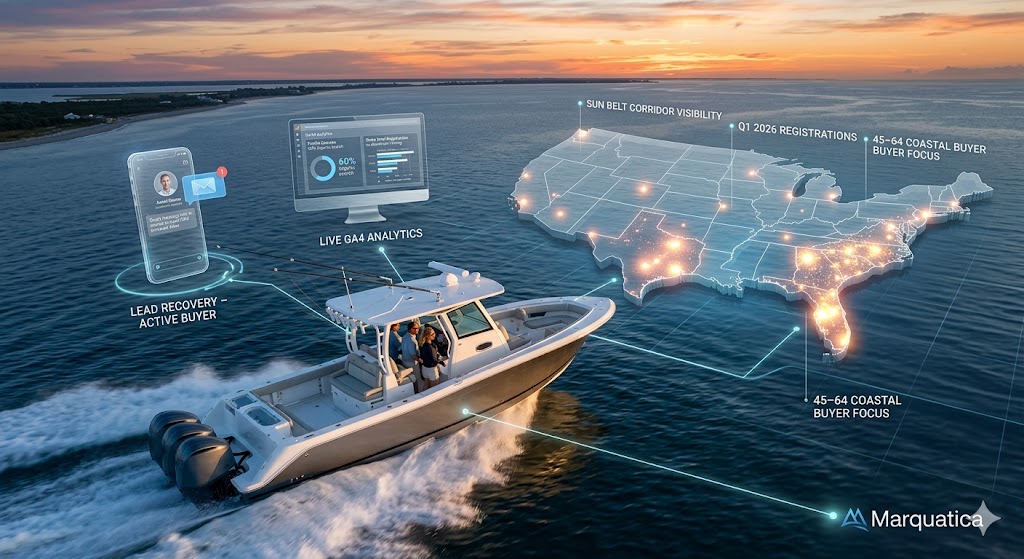
Florida alone accounts for 1.2 million boat registrations — 10% of all U.S. registrations. The South Atlantic region grew 12.4% to 2.2 million boats. The same migration corridors driving Millennial wealth concentration — Austin, Tampa, Nashville, Raleigh-Charlotte, Atlanta, Phoenix, Denver — are the same markets where marine website analytics show the strongest audience concentration across virtually every boat category.
This is not a coincidence. It is the intersection of three forces: climate, demographics, and infrastructure.
The Great Lakes corridor remains important, particularly for freshwater fishing categories. But the growth edge is clearly southward and inland. Brands that have historically oriented their marketing and dealer development toward the Midwest and Northeast are increasingly marketing to where their buyers used to be, not where they are going.
What Each Buyer Segment Actually Looks Like
The Wake and Tow Boat Buyer
This buyer is aspirational, digitally engaged, and increasingly price sensitive. Website analytics across the wake/tow category show a buyer who is predominantly mobile (approximately 60–70%), browsing at the top of the funnel rather than deep in the research phase. Direct traffic dominates — meaning brand awareness is strong, but conversion is the challenge.
The geographic concentration is Sun Belt-heavy: Florida, Texas, California, and the Mountain West (Idaho, Arizona, Colorado) lead session volume. These are inland lake markets with strong wake sport cultures.
The structural challenge for this segment is the price gap. Google Trends data shows that wakeboard boat search interest peaked in 2005 and has been in structural decline since, while wake surf interest grew to replace it — peaking in 2020 and now normalizing 3. The buyer exists. The desire exists. The $187,000 average price tag is the barrier. Brands that can credibly offer a sub-$60K entry-tier product — or a path to ownership through clubs, rentals, or financing — will capture the next generation of wake sport enthusiasts before they age out of the aspiration.
The Tournament Bass Boat Buyer
This is the most search-driven buyer in the marine category. Organic search accounts for approximately 60% of website traffic for leading bass boat brands — the highest organic search dependency in the category. This buyer actively researches specifications, tournament results, dealer inventory, and competitive comparisons before making contact. Desktop sessions show significantly higher engagement rates than mobile, reflecting deliberate, research-oriented behavior.
Geographically, the tournament bass boat buyer is concentrated in Texas, the Deep South (Georgia, Alabama, Arkansas), and the Midwest (Illinois, Minnesota). These markets map precisely onto the major bass tournament circuits — B.A.S.S., FLW, and Major League Fishing. Tournament sponsorship and pro staff visibility are not optional marketing for this segment; they are table stakes for credibility.
The bass boat segment declined 8.8% in 2025, but the leading brands in this category are outperforming that trend significantly — in some cases growing in Q1 2026 while the segment contracts. The tournament angler identity is more durable than lifestyle or aspirational identities. This buyer knows what they want, researches it thoroughly, and is less susceptible to the affordability pressure squeezing the wake/tow category because the purchase decision is driven by performance requirements, not status.
The Offshore and Coastal Buyer
The GA4 demographic data for offshore and center console categories is the clearest of any segment: this is a 45–64-year-old male buyer, with engagement rates peaking in the 55–64 age cohort. This is the most financially established buyer in the marine market — less sensitive to interest rate pressure, less sensitive to price increases, and more likely to be a repeat buyer upgrading from a previous vessel.
Geographically, this buyer is concentrated in the Atlantic coastal corridor: Florida, New York, Georgia, North Carolina, New Jersey, Virginia. West Coast presence is meaningful for center console categories. The paid search channel performs well for this buyer — approximately 19% of sessions for leading offshore brands come from paid search, indicating active in-market behavior responding to search advertising.
Both offshore and center console categories showed positive Q1 2026 registration growth despite the broader market decline. The 45–64 coastal buyer migrating to Florida and the Southeast is the most reliable near-term demand driver in the premium marine market.
The Freshwater Fishing Buyer (Great Lakes)
This buyer is geographically the most constrained and demographically the oldest of the segments examined. Website analytics for Great Lakes-oriented fishing brands show Minnesota, Wisconsin, Illinois, North Dakota, and Michigan as the dominant states — with virtually no Sun Belt presence. Desktop engagement rates are the highest of any segment (50%+), consistent with an older, deliberate buyer.
This segment is not growing. But it is stable, and the paid search channel is efficient for capturing in-market buyers — brands in this category see a healthy number of sessions from paid search, suggesting that buyers are actively searching for specific products when they are ready to purchase. The marketing challenge is not awareness; it is conversion efficiency.
The Window That Is Opening: 2026–2033
The most important context for all the above is a macro shift that is just beginning. Cerulli Associates estimates that $124 trillion in wealth will transfer by 2048, with approximately $1 trillion per year already transferring now. Gen X inheritance peaks between 2026 and 2033. Millennial wealth is hitting critical mass in the same window.
Ipsos and NMMA identified 35 million high-potential new boat buyers in March 2026. These buyers are concentrated in the Sun Belt metros. They are digital-first — McKinsey research shows that Millennial buyers arrive at dealerships having already made their purchase decision online. They need accessible entry price points, digital buying experiences, and a path from access (boat clubs, rentals, fractional ownership) to full ownership.
The brands that will win the next decade are not the ones that wait for the market to recover to 2021 levels. They are the ones that are building the on-ramp for this buyer right now — through entry-tier products, digital-first retail experiences, and marketing that meets the 35–44-year-old Sun Belt buyer where they are, not where the industry assumed they would be.
What This Means for Marine Marketing in 2026
Where your buyers are, where your products sit, and how your budget flows should tell the same story. Right now, for most marine brands, they don’t. Geography, pricing, and channel strategy are operating in parallel instead of in sync.
Three calculations — geography vs. spend, segment mix vs. price tier, and channel mix vs. buyer behavior — are enough to surface it. Each one produces a number. Each number points to a decision.
The data points to three actionable conclusions for marine brands and their marketing partners:
First, geography is the most underutilized lever. Most marine brands still allocate media budgets based on historical dealer geography rather than where buyers are concentrating. The Sun Belt shift is not a future trend — it is present tense. Florida, Texas, Georgia, Arizona, and North Carolina should be overweighted in media allocation relative to their historical share.
Pull state-level new-boat registrations for your category over the last 24 months from SSI (or your dealer registration data). Plot it against your media-spend distribution by state for the same window. Find the largest mismatch — the state where registration share has grown faster than your spend share. The size of that mismatch is the size of the geographic reallocation opportunity you currently have on the table.
Second, the buyer journey is longer and more digital than the industry acknowledges. The dominance of organic search (60% of sessions for fishing categories) and direct traffic (83%+ for premium wake brands) means buyers are doing extensive research before any paid media touchpoint. Content that serves the research phase — specifications, comparisons, dealer locators, financing tools — is not a nice-to-have. It is the primary conversion driver.
Pull your unit sales by price tier (under $60K, $60–125K, $125–250K, $250K+) over the last 24 months. Compare to industry registration trends in each tier over the same period. If your mix is concentrated above $125K and the industry trend below $60K is growing while above $125K is contracting, the gap is the structural pressure on your forecast.
Third, the affordability gap is the defining challenge of the next five years. The brands that solve for sub-$60K entry points, credible pre-owned programs, or club/rental on-ramps will capture the 35 million high-potential buyers identified by Ipsos/NMMA. The brands that do not will continue marketing to a shrinking pool of buyers who can afford $187,000 average prices.
Pull the share of sessions from organic search, direct, paid search, paid social, and referral for the last 90 days. Compare to your media spend by channel. If 60% of your traffic is organic but 80% of your media spend is paid social, the planning model and the buyer behavior are out of sync. The reconciliation goes in either direction depending on what your funnel actually needs.
The market is not broken. It is telling you exactly who it is and where it is going. The question is whether your strategy is listening.
About Marquatica
Marquatica is a marine-industry growth agency. We build the operating layer underneath your marketing, the part that turns demand into delivery. The capabilities the benefit our clients most include:
·Audience intelligence tools that identify in-market buyers across the web with unmatched ROI through our targeted campaigns
·A marine-focused CRM with a universal inbox with text and voice AI across email, web form, chat, SMS, phone, and social DM integrated
·Lifecycle email and SMS automation including reactivation of dormant contacts in your CRM and lead recovery when dealer handoff has an issue
·Live dashboards for full visibility into marketing performance, ad spend by channel, and pipeline activity at every stage of the funnel
If you'd like to learn more about how we can optimize and accelerate your growth, take our complimentary audit.
Sources cited: SSI registration records (full year 2025, Q1 2026), Google Trends (2005–2025), Cerulli Associates wealth-transfer projections, Ipsos/NMMA March 2026 buyer research, McKinsey research on Millennial dealer behavior, GA4 analytics across marine OEMs.